Muladhara, the root chakra, is the first of the seven main chakras. It sits at the base of the spine and is linked to safety, stability and our connection to the earth. When Muladhara is balanced, you feel grounded, secure and calm. When it is blocked, you may feel anxious, restless or unsafe.
The very first chakra located right at the beginning of the spinal column is known as MULADHARA (ROOT+ FOUNDATION). The two words conjoin to form the basic sense of this primal chakra which translates to be “where the basic roots are established”. The theory of chakras comes with a long list of associated spiritual parameters as well. The most important being the fundamental elements (MAHABHOOT) associated with each of them. In the case of MULADHARA, the associated element is PRITHVI( = earth). Apart from this, there are a number of petals, associated syllable and respective deities and other such spiritual dimensions along with the color as well.

Muladhara Chakra
MULADHARA chakra is where the KUNDALINI is supposed to be dormant in deep sleep coiled and being the very first Chakra this chakra is also known as the root chakra. In a manner of saying it is the actual root of this complete divine tree of human consciousness. Our very planet EARTH is the key indicator of what matter is, beyond that too the perceivable material form of existence is understood through this very root chakra since it is the first step of realization for anyone of us.
This realization begins for each and every creature since birth as we come in contact with it every time and everywhere. Our own shape, size, and structure are also part of this material aspect which is generally known as matter. That is what PRITHVI element represents. The Muladhara or root chakra is essentially the knowledge and realization of this material form in totality, something which we are continuously engaged in as we dwell, live and understand it firsthand as whatever is perceivable right in front to the senses is the very thing we comprehend. The root chakra paves the way for the KUNDALINI to begin its process of ascension ahead moving through the spine upwards.
The MULADHARA chakra corresponds to the anal region within the physical body.
Muladhara Chakra Meaning and Location
The Sanskrit word Muladhara combines mula (root) and adhara (support or base). It is located at the base of the spine, near the perineum. In Kundalini yoga, this is where the dormant Kundalini energy is said to rest, coiled like a sleeping serpent.
Key Qualities of the Root Chakra
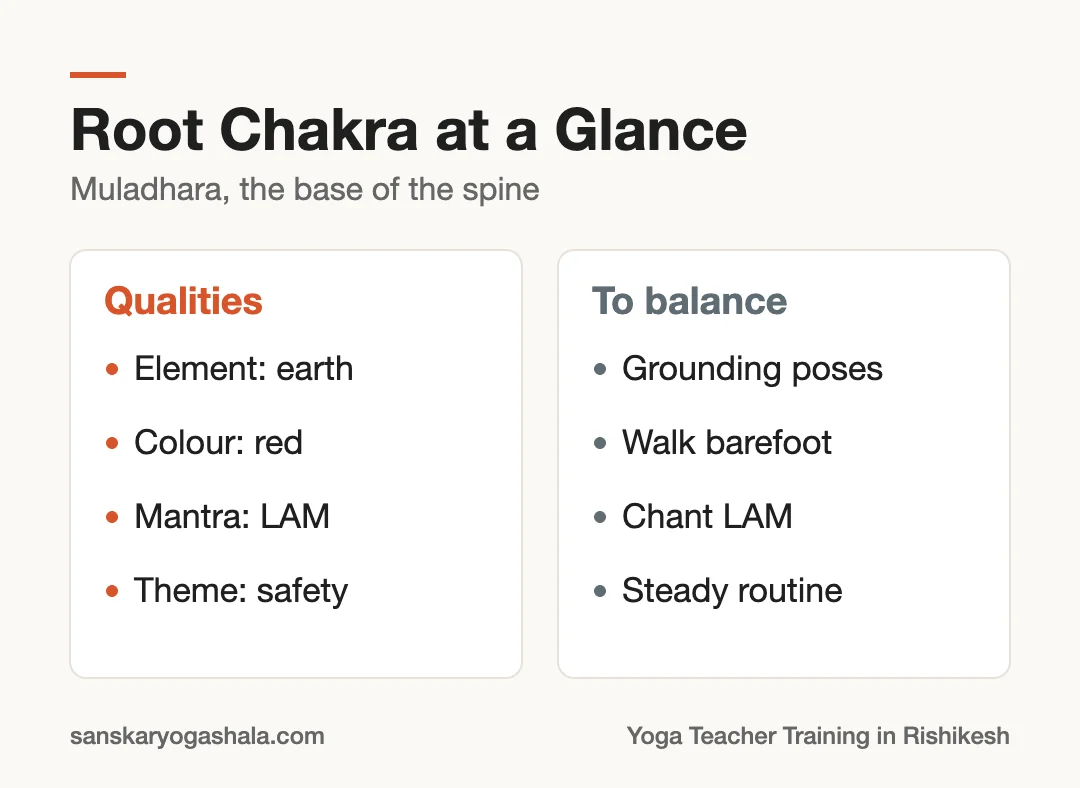
- Element: earth
- Colour: red
- Seed mantra (bija): LAM
- Symbol: a lotus with four petals around a square
- Themes: survival, security, stability, trust and belonging
Signs of a Balanced and Blocked Muladhara
A balanced root chakra shows up as a calm, steady mind, good energy, healthy routines and a feeling of being at home in your body. A blocked or weak root chakra may show up as fear, worry about money or safety, restlessness, tiredness, lower back or leg problems and difficulty settling in one place.
How to Balance the Root Chakra
- Grounding asanas: Tadasana, Malasana, Virabhadrasana and Balasana help you feel rooted.
- Walk barefoot: spend time on grass, soil or sand.
- Chant LAM: sit quietly and chant the seed sound while focusing on the base of the spine.
- Slow breathing: long, deep exhalations calm the nervous system.
- Routine: regular sleep, meals and practice give the body a sense of safety.
- Earthy foods: root vegetables and simple warm meals support grounding.
Why the Root Chakra Comes First
Every building needs a strong foundation. In the same way, the higher chakras linked to love, expression and insight depend on a steady root. That is why many teachers begin chakra and Kundalini practice with Muladhara. Learn more in our guide to the seven Kundalini chakras.
Root Chakra Meditation for Beginners
Sit comfortably with a straight spine and close your eyes. Bring your attention to the base of the spine and imagine a warm red light glowing there. Breathe slowly and, on each exhale, feel your body becoming heavier and more supported by the ground. Silently repeat LAM for five to ten minutes. Finish by placing your palms on the floor and taking three deep breaths. Practised daily, this simple meditation builds a calm, steady feeling of safety.
To go deeper into chakra work, our Kundalini yoga teacher training teaches chakra meditation, mantra and kriya step by step.
Related reading: the Kundalini chakras and Kundalini yoga in Rishikesh. To study Kundalini yoga in depth, see our Kundalini Yoga Teacher Training in Rishikesh.
Root Chakra FAQs
Where is the Muladhara chakra located?
Muladhara is located at the base of the spine, around the area of the perineum and tailbone.
What is the mantra for the root chakra?
The seed mantra (bija) for Muladhara is LAM.
What colour is the root chakra?
The root chakra is traditionally linked to the colour red.
What are the signs of a blocked root chakra?
Common signs include anxiety, fear, restlessness, low energy, money worries and a feeling of not being grounded.
Which yoga poses help the root chakra?
Grounding poses such as Tadasana, Malasana, Warrior poses and Child’s Pose are helpful for balancing Muladhara.