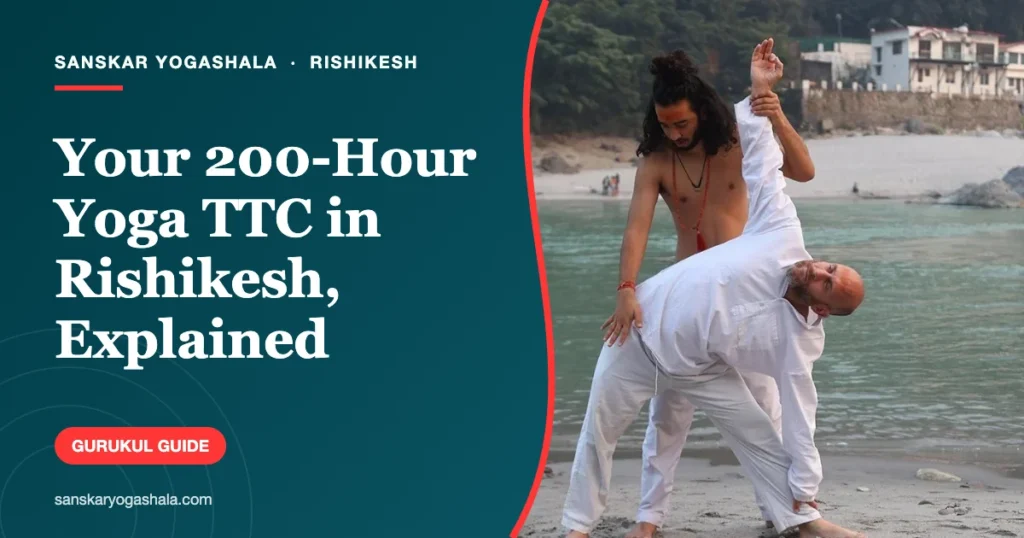
Enrolling in an authentic 200 hour yoga teacher training in rishikesh is the ultimate foundation to master classical asana biomechanics, breathwork, and international teaching credentials. Yet, most commercial schools in Tapovan pack 40 to 60 students into hurried classes, leaving trainees without personal alignment guidance or authentic spiritual depth.
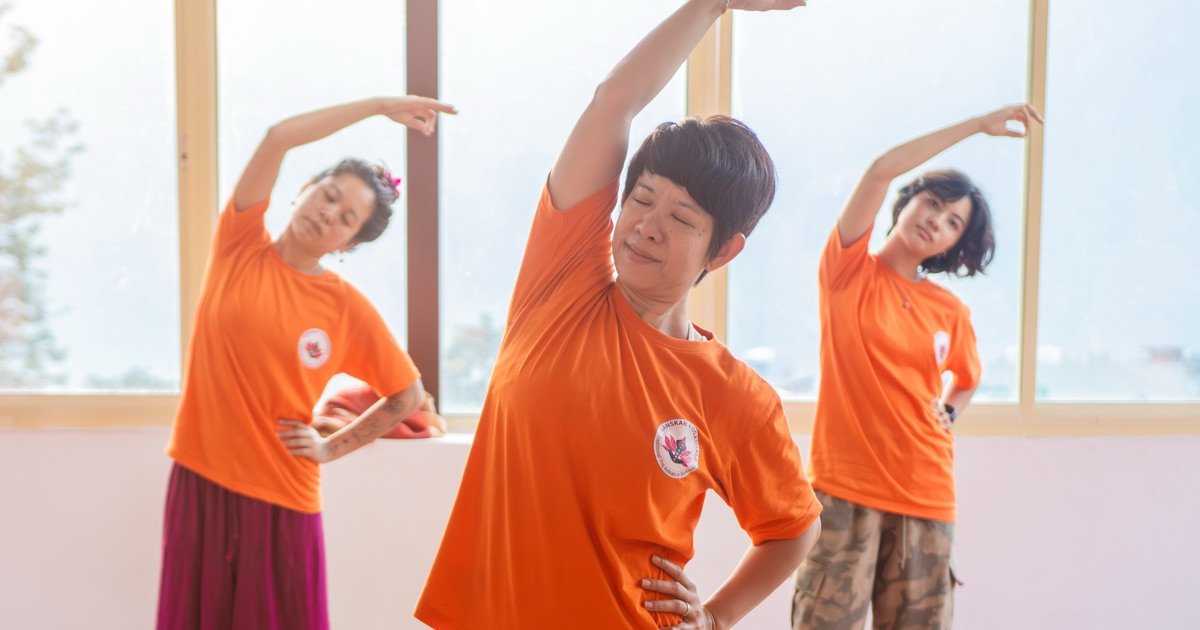
At Sanskar Yogashala, we solve this through traditional Gurukul integrity. Directed by Yog Guru Naveen Joshi (M.Sc. in Yogic Science), our ashram strictly limits cohorts to 15 students. Over 28 immersive residential days accredited by Yoga Alliance USA Standards, you receive daily hands-on posture adjustments, traditional Hatha and Ashtanga sequencing, Shatkarma cleansing, and living Vedic philosophy along the holy Ganges.
Key Takeaways
- Global Teaching Credential: Graduating from this 28-day residential immersion earns the internationally recognized Yoga Alliance USA RYT 200 credential, qualifying graduates to teach legally worldwide.
- Strict 15-Student Batch Cap: While commercial schools train 40 to 60 students per batch, Sanskar Yogashala enforces a 15-student limit to guarantee daily hands-on alignment corrections.
- Academic Degree-Holding Masters: Classes are directed by Yog Guru Naveen Joshi, who holds a Master of Science (M.Sc.) in Yogic Science from Uttarakhand Sanskrit University and over 15 years of continuous teaching experience.
- Complete Residential Package: All-inclusive tuition ranges from $799 to $1,299 USD, covering 28 nights of private or shared accommodation, three daily sattvic Ayurvedic meals, textbooks, Shatkarma cleansing tools, and Himalayan excursions.
- Clinical Neuro-Respiratory Training: Breathwork modules integrate peer-reviewed breath retention ratios proven by NCBI clinical research to downregulate sympathetic stress biomarkers and enhance vagal nerve tone.

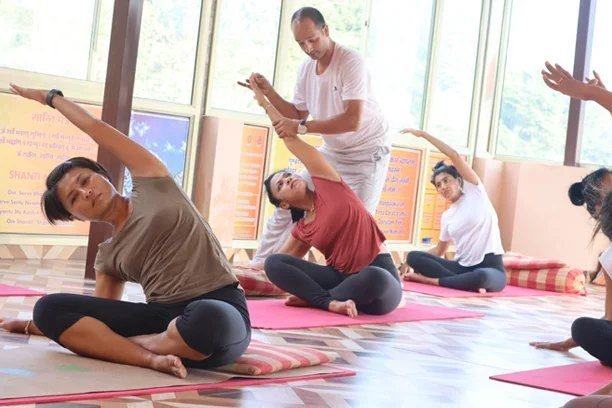
Spiritual Geography of Tapovan: Why Study in Rishikesh?
Geographic vibration and institutional authenticity fundamentally determine the depth of your personal transformation. Rishikesh sits where the emerald waters of the sacred Ganges River descend from the Garhwal Himalayas into the northern plains of Uttarakhand. For millennia, Vedic rishis, saints, and Shankaracharyas established ashrams within these foothills, creating a concentrated environment dedicated entirely to self-realization (Atma-Jnana).
The Himalayan Sacred Energy of Upper Tapovan
Within Rishikesh, the quiet hillside district of Tapovan serves as the primary sanctuary for serious yoga students. Located slightly elevated from the bustling market streets, Tapovan provides clean mountain airflow, immediate trail access to Himalayan meditation caves, and peaceful walking proximity to the riverbanks without vehicle congestion.
- Sacred Topography: Perched along the emerald Ganges at the foothills of the Himalayas, creating an electrically charged atmosphere for intensive breathwork and meditation.
- Vedic Gurukul Living: Rooted in traditional ashram discipline where students adopt early rising, silence (Mauna), and communal study without modern distractions.
- Living Himalayan Rituals: Daily practice intersects with living spiritual ceremonies, including dawn temple chanting, sacred Vedic fire hawans, and evening Ganga Aarti.
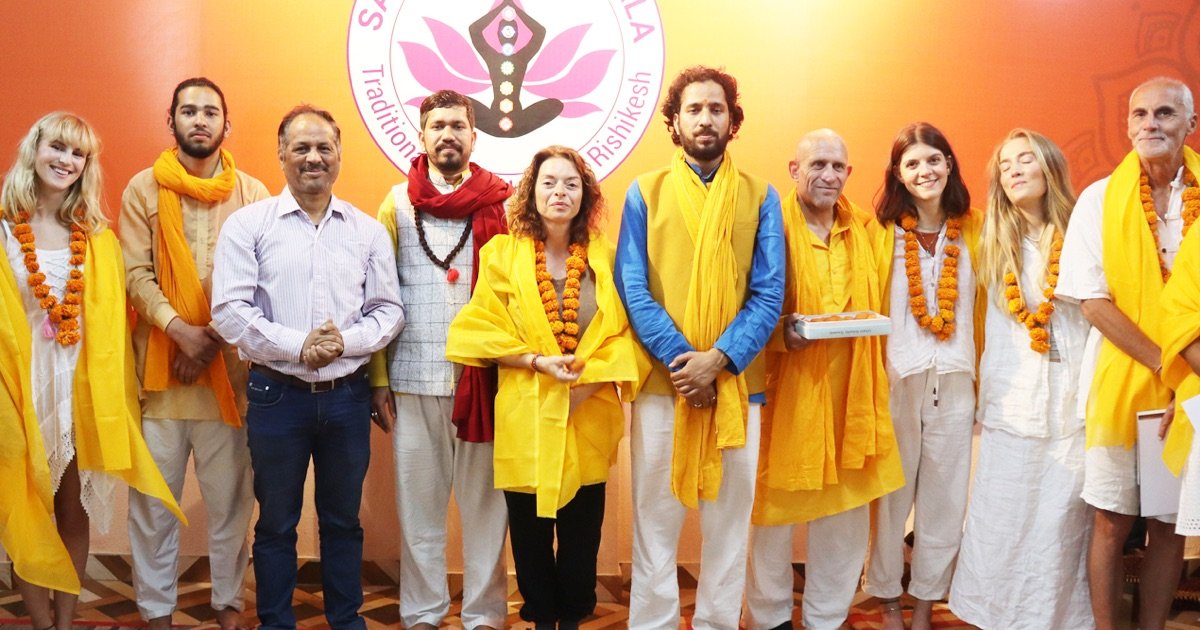
- Direct Brahmin Lineage: Direct access to native Uttarakhand masters like Yog Guru Naveen Joshi and Yogi Ajay Joshi, preserving authentic scriptural lineages.
- Deep Introspective Stillness: Fosters profound inner transformation by stripping away commercial consumerist noise and urban stress.
The Living Ashrams of Swargashram & Lakshman Jhula
The vibrant spiritual quarter spanning Lakshman Jhula and Tapovan has nurtured spiritual seekers for generations. Living in an ashram environment integrates practical disciplines learned on the mat into everyday existence.
- Pristine Nature Trails: Surrounded by Himalayan sal forests and natural freshwater springs that encourage mental tranquility.
- Spiritual Community: Draws dedicated practitioners from over 40 countries, creating an uplifting global fellowship of yoga teachers.
- Ayurvedic Healing Ecosystem: Surrounded by authentic herbal dispensaries, Panchakarma therapy clinics, and classical Sanskrit libraries.
Comprehensive Curriculum Architecture: The 200-Hour Yoga Alliance Standard
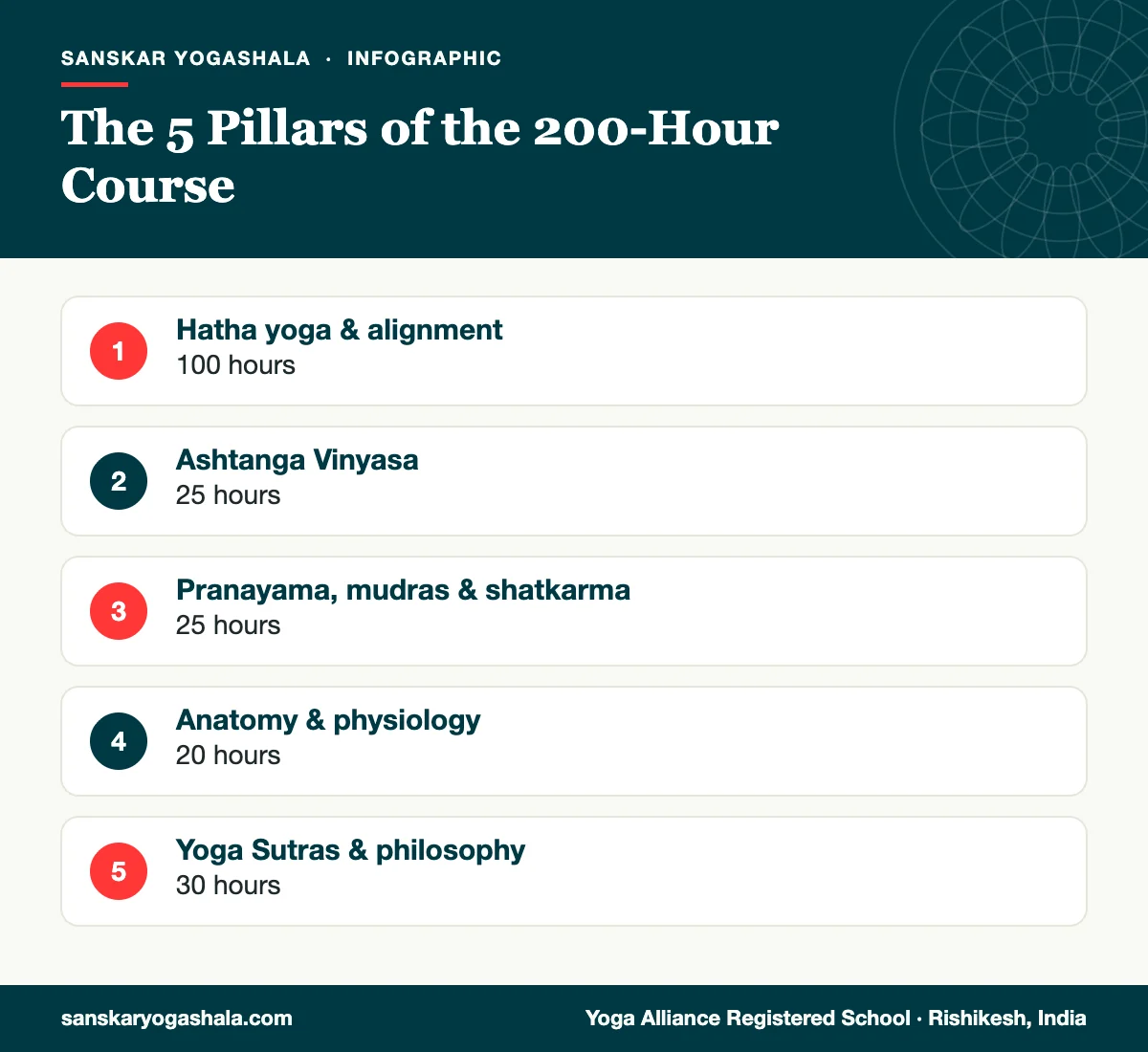
Our curriculum satisfies and exceeds the elevated standards established by Yoga Alliance USA. The 200 contact hours are divided across five distinct educational pillars, ensuring every graduate leaves with safe adjustment skills, anatomical literacy, and confident teaching methodology.
Module 1: Classical Traditional Hatha Yoga & Alignment Biomechanics (100 Hours)
Classical Hatha Yoga forms the physical and energetic cornerstone of our foundational training. Instruction focuses on deliberate, static posture holds designed to stabilize the nervous system, build muscular endurance, and channel prana through the subtle energy channels (Nadis).
- Biomechanical Joint Stacking: Understanding skeletal architecture, safe weight distribution, and pelvic stabilization across standing, seated, and inverted postures.
- Prop Mechanics: Systematic utilization of wooden blocks, cotton straps, bolsters, and wall ropes to adapt classical asanas to diverse body types and joint restrictions.
- Spinal Decompression Principles: Mastering axial elongation and core recruitment during extension and flexion to protect the lumbar vertebrae.
- Static Endurance & Breath Integration: Holding foundational postures for 5 to 10 conscious breaths, synchronizing diaphragmatic expansion with muscular relaxation.
Module 2: Ashtanga Vinyasa Primary Series & Mysore Adjustments (25 Hours)
Ashtanga Vinyasa introduces dynamic heat, cardiovascular stamina, and rhythmic movement into your physical practice. Students dissect the foundational Chikitsa (Yoga Therapy) sequence of the Primary Series.
- Surya Namaskar A & B: Refining the 9 vinyasas of Sun Salutation A and the 17 vinyasas of Sun Salutation B with precise breath-movement coordination (Vinyasa Krama).
- Tristhana Focus System: The three points of transformative attention: physical posture alignment (Asana), focused ocular gazing points (Drishti), and internal energetic locks (Bandhas).
- Ujjayi Pranayama Integration: Cultivating the victorious ocean breath to maintain internal core heat, regulate cardiac pace, and induce nervous system grounding.
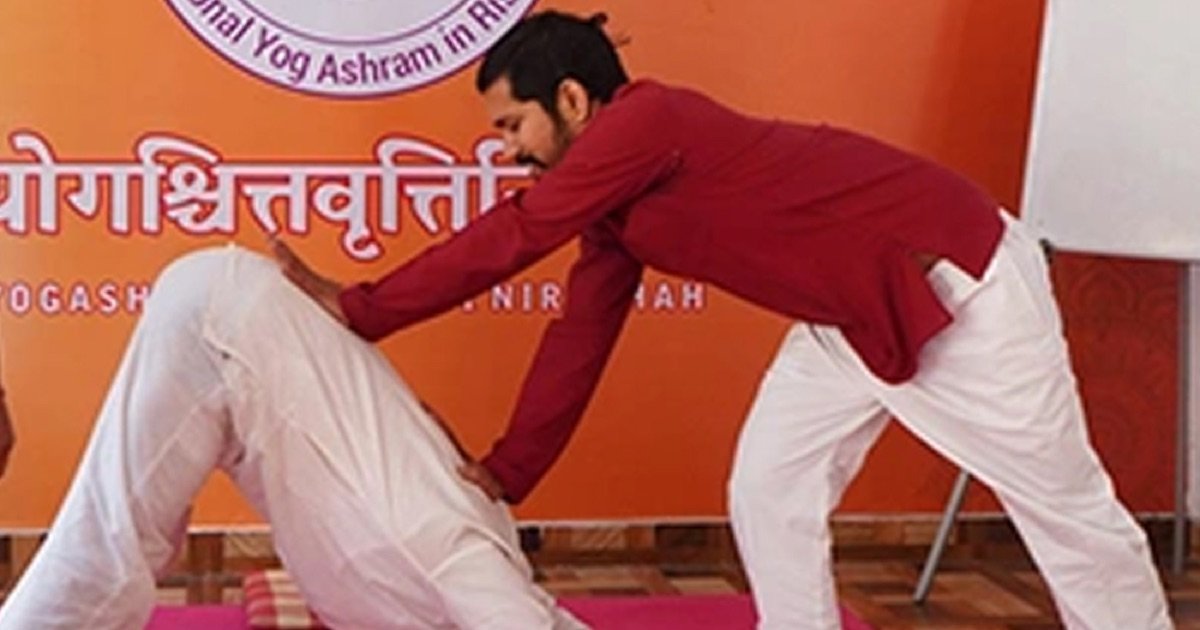
- Hands-On Mysore Corrections: Developing tactile sensitivity, body leverage, and student consent protocols to adjust forward folds, twists, and backbends safely.
Module 3: Pranayama, Mudras & Shatkarma Kriyas (25 Hours)
Breath control and physical purification prepare the mind for sustained meditation by clearing physical toxins and balancing the autonomic nervous system.
- Shatkarma Cleansing Techniques: Daily morning execution of Jala Neti (saline nasal irrigation), Sutra Neti (cotton cord nasal cleansing), Kapalbhati (frontal brain purification), and Trataka (candle-gaze concentration).
- Classical Breath Retention (Kumbhaka): Progressive training in Puraka (inhalation), Rechaka (exhalation), and Antar/Bahir Kumbhaka (internal and external breath holds) with strict pulse monitoring.
- Major Pranic Breathing Modalities: Mastering Nadi Shodhana (alternate nostril breathing for hemisphere balance), Bhastrika (bellows breath for metabolic vitality), Ujjayi, and Sheetali/Sheetkari (cooling breaths).
- The Three Great Bandhas: Anatomical activation of Mula Bandha (perineal contraction), Uddiyana Bandha (abdominal lift), and Jalandhara Bandha (throat lock) to seal vital life force within the central Sushumna channel.
Module 4: Functional Anatomy, Physiology & Kinesiology (20 Hours)
Modern yoga teachers must possess rigorous anatomical literacy to prevent joint injuries and guide students through safe mechanical progressions.
- Musculoskeletal Mechanics: Detailed study of major joint complexes (hip capsule, glenohumeral shoulder joint, knee ligaments, and spinal curvatures).
- Fascial Webs and Tensegrity: Exploring myofascial meridian lines and how kinetic tension in the foot arches influences cervical spine alignment.
- Autonomic Nervous Regulation: Understanding how specific breathing techniques activate the vagus nerve, downregulate sympathetic fight-or-flight states, and induce parasympathetic recovery.
- Postural Pathologies: Identifying anterior pelvic tilt, kyphosis, scoliosis, and rotator cuff impingements, applying targeted contraindications.
Module 5: Patanjali Yoga Sutras & Vedic Philosophy (30 Hours)
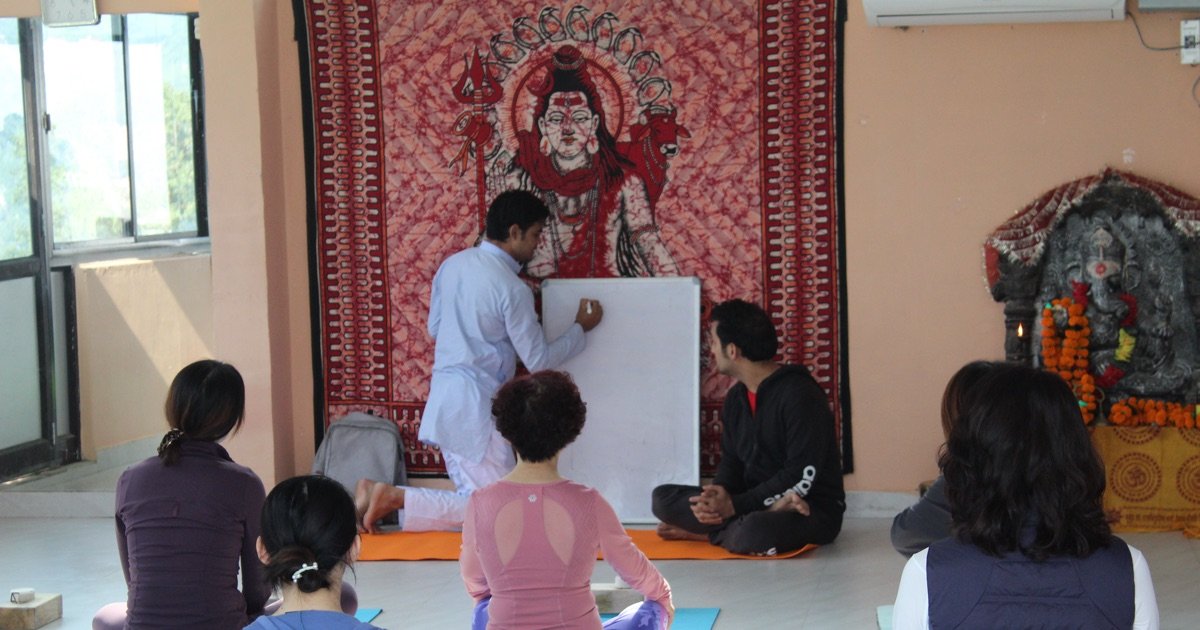
Yoga is fundamentally an internal science of consciousness rather than physical gymnastics. Led by Yog Guru Naveen Joshi, students examine original Sanskrit scriptures to ground their modern teaching in classical ethics.
- The Eight Limbs of Classical Yoga (Ashtanga): Deep study of Yama (ethical restraints), Niyama (personal observances), Asana, Pranayama, Pratyahara (sensory withdrawal), Dharana (concentration), Dhyana (meditation), and Samadhi (absorption).
- Patanjali’s Definition of Yoga: Unpacking Yogas Chitta Vritti Nirodha (Yoga is the cessation of mental fluctuations) and practical mechanisms to quiet the reactive ego.
- Sankhya Philosophy & The Three Gunas: Understanding cosmic manifestation through Purusha (pure consciousness) and Prakriti (material nature), analyzing Sattva, Rajas, and Tamas.
- Bhagavad Gita Ethics: Applying Karma Yoga (selfless duty without attachment to outcomes) to daily life and modern business conduct.
To explore how these foundational subjects transition into higher credentials, review our complete master guide on 500 hour yoga teacher training in rishikesh or advance your sequencing with our 300 hour yoga teacher training rishikesh.
Operational Comparison: Sanskar Yogashala vs. Leading Rishikesh Schools
Choosing the right institution requires transparent evaluation of cohort limits, teaching faculty credentials, and campus environment. The table below outlines how Sanskar Yogashala compares against prominent regional schools:
| Operational Dimension | Sanskar Yogashala (Tapovan) | Large Commercial Academies | Generic Multi-Style Schools |
|---|---|---|---|
| Cohort Student Limit | Strictly capped at 15 students (Personal adjustment guarantee) | 35 to 55 students per batch | 25 to 40 students per batch |
| Lead Faculty Credentials | M.Sc. Yogic Science (University Degree), Traditional Brahmin Lineage | E-RYT 500, varying commercial certificates | Junior assistant instructors, rotating teachers |
| Daily Adjustment Attention | Personal daily correction by master gurus | Spot corrections by assistants | Limited personal adjustment |
| Curriculum Focus | Classical Gurukul Hatha, Ashtanga, Kundalini & Shatkarma | Fast-paced Vinyasa flow, Western gym pacing | Multi-style survey (broad, less depth) |
| Shatkarma Cleansing | Complete daily practical training (Jala & Sutra Neti) | Theory demonstration only | Weekly brief practice |
| Campus Location | Peaceful upper Tapovan, walking distance to Ganges | Busy commercial lanes or isolated outer villages | High-traffic tourist strips |
| All-Inclusive 200-Hr Fee | $799 – $1,299 USD (Complete transparent pricing) | $1,200 – $1,600 USD | $850 – $1,350 USD |
| Mentorship Guarantee | Guaranteed personal mentoring from Yogi Naveen | Rotating guest instructors | High student turnover |
A Day in the Ashram: Hour-by-Hour Dinacharya Schedule
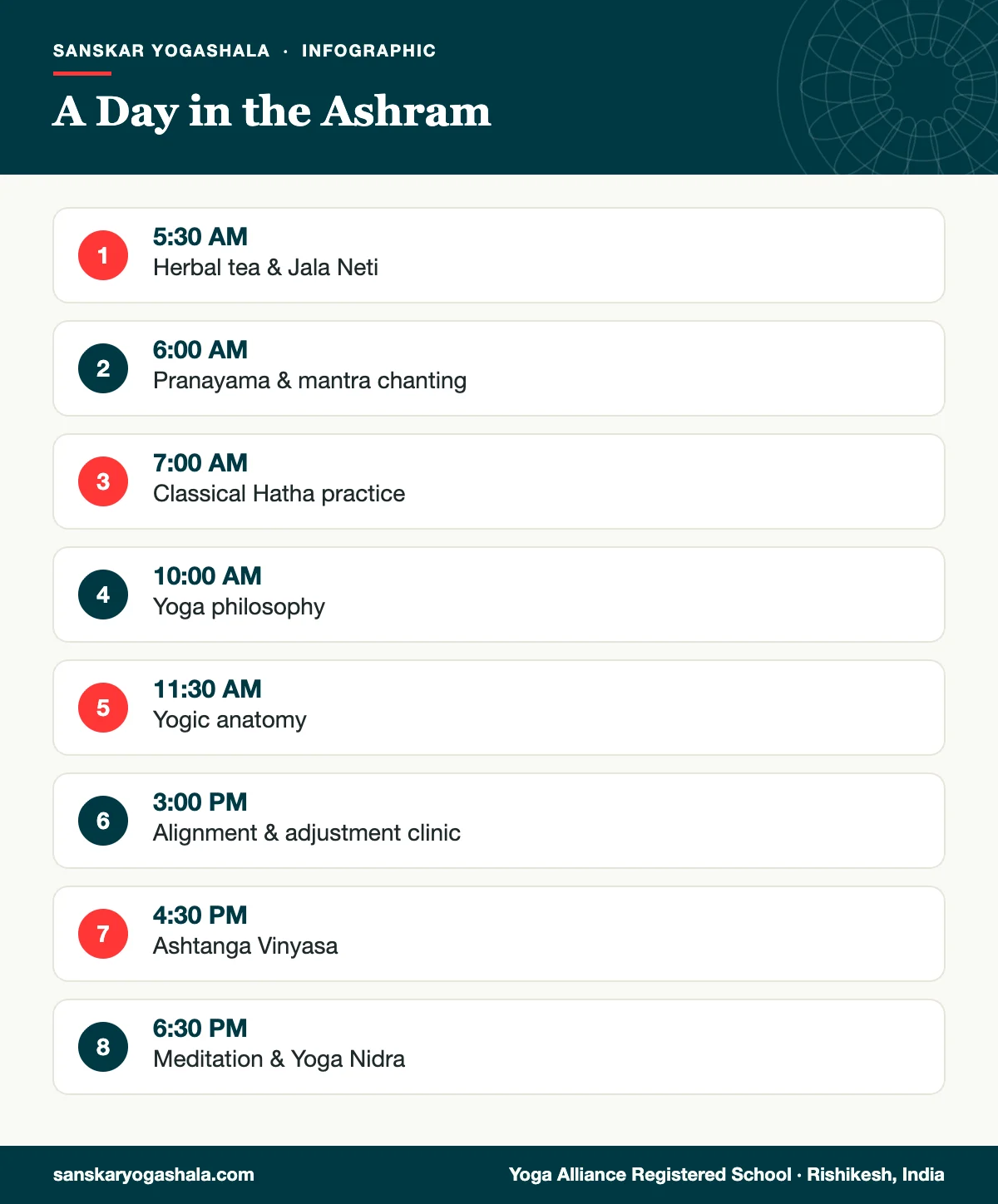
In our Tapovan ashram, daily practice synchronizes with natural biological rhythms (Dinacharya) as prescribed in ancient Ayurvedic science. Rising before the dawn awakens metabolic vitality and prepares the mind for deep contemplative focus:
- 05:30 AM – 06:00 AM: Morning Bell, Herbal Detox Tea & Daily Shatkarma (Jala Neti nasal irrigation).
- 06:00 AM – 07:00 AM: Pranayama (Breath Regulation), Bandhas & Vedic Mantra Chanting.
- 07:00 AM – 08:45 AM: Classical Hatha Yoga Practice (Precision Postural Biomechanics & Alignment).
- 08:45 AM – 10:00 AM: Wholesome Sattvic Ayurvedic Breakfast & Morning Rest.
- 10:00 AM – 11:15 AM: Yoga Philosophy (Patanjali Yoga Sutras, Bhagavad Gita & Gurukul Ethics).
- 11:30 AM – 12:45 PM: Functional Yogic Anatomy & Musculoskeletal Biomechanics.
- 01:00 PM – 03:00 PM: Nourishing Ayurvedic Lunch, Digestion & Personal Study (Svadhyaya).
- 03:00 PM – 04:15 PM: Asana Alignment Clinic & Hands-On Posture Adjustment Workshops.
- 04:30 PM – 06:15 PM: Dynamic Ashtanga Vinyasa Primary Series (Mysore-Style Flow).
- 06:30 PM – 07:30 PM: Guided Meditation, Yoga Nidra & Breath Reflection.
- 07:30 PM – 08:30 PM: Warm Sattvic Vegetarian Dinner & Community Sharing (Satsang).
- 08:30 PM – 09:30 PM: Self-Study, Journaling & Silent Contemplation.
- 10:00 PM: Lights Out & Sacred Silence (Mauna).
For prospective teachers with limited time commitments, our foundational curriculum can also be undertaken as an introductory 100 hour yoga teacher training in rishikesh. If you seek an international experience taught by our native Indian faculty, explore our yoga teacher training in thailand.
Residential Living Standards: Sattvic Food and Clean Accommodation
A rigorous physical training schedule requires clean living environments and biologically restorative nutrition. We eliminate common accommodation anxieties by maintaining high hygienic standards in our peaceful Tapovan shala.
Private & Shared Accommodations
Our residential facility provides spacious, light-filled rooms equipped with comfortable orthopedic mattresses, fresh cotton linens, private attached bathrooms, continuous 24/7 solar hot water systems, high-speed Wi-Fi connectivity, and private balconies overlooking the surrounding Himalayan ridges. Single private rooms are available for practitioners seeking complete privacy, while twin-shared rooms allow meaningful connection with fellow international students.
The Sattvic Ayurvedic Kitchen
Digestive ease directly impacts mental stillness and physical flexibility. Our kitchen prepares three wholesome vegetarian meals daily, utilizing seasonal, locally sourced Himalayan produce:
- Breakfast: Wholesome warm oatmeal, cracked wheat porridge (Daliya), fresh seasonal fruits, soaked almonds, herbal digestive teas, and freshly prepared flatbreads.
- Lunch: Digestible yellow mung lentils (Dal), steamed basmati rice, freshly rolled whole-wheat rotis, seasonal vegetable curries, and soothing Ayurvedic buttermilk.
- Dinner: Light vegetable broths, steamed seasonal greens, khichdi, and herbal digestive infusions designed to promote sound, restorative sleep.
All meals are prepared fresh with minimal oil and digestive spices such as cumin, turmeric, coriander, and ginger. We easily accommodate vegan, gluten-free, and nut-free dietary requirements with advance notice. Detailed facility images and dining standards can be viewed on our ashram accommodation in rishikesh overview. Those seeking relaxation without exams can also explore our yoga retreats in india or our popular 3 days yoga retreat in rishikesh.
Comprehensive Cost Comparison: Calculating Your Total Investment
Pursuing a yoga certification in India represents an affordable educational investment compared to Western certification studios charging upwards of $3,500 USD for weekend-only tuition. Here is a clear, itemized financial projection for completing your 200-hour training at Sanskar Yogashala in 2026:
| Expenditure Category | Sanskar Yogashala Inclusions | Estimated Expense (USD) |
|---|---|---|
| Residential Tuition & Lodging | 28 nights accommodation (private or shared room with hot bath) | $799 – $1,299 USD |
| All Daily Meals | 3 freshly prepared sattvic Ayurvedic vegetarian meals daily | Included in course fee |
| Textbooks & Course Manuals | Comprehensive illustrated manuals, philosophy & anatomy books | Included in course fee |
| Shatkarma Cleansing Kit | Copper Neti pot, Sutra cord & cleansing tools | Included in course fee |
| Himalayan Cultural Excursions | Ganga beach meditation, cave visits, temple treks | Included in course fee |
| Estimated Roundtrip Flight | Flight to New Delhi (DEL) + domestic flight to Dehradun (DED) | $650 – $1,200 USD |
| Indian Government Visa Fee | 30-day or 1-year Indian e-Tourist Visa applied online | $25 – $40 USD |
| Discretionary Personal Expenses | Laundry, local cafes, personal shopping in Tapovan | $100 – $200 USD |
| Total Estimated Outlay | Complete all-inclusive educational and travel investment | $1,574 – $2,739 USD |
Decision Framework: Is Sanskar Yogashala Right for You?
Selecting your training sanctuary requires alignment between your personal aspirations and an ashram’s operational ethos.
You Should Choose Sanskar Yogashala If:
- You demand small cohort sizes: You thrive in an intimate environment capped at 15 students where master teachers know your physical strengths, anatomical limitations, and spiritual goals.
- You seek authentic university-educated masters: You wish to learn directly from native Indian masters like Yog Guru Naveen Joshi, holding academic M.Sc. Yogic Science degrees and unbroken Brahmin heritage.
- You value classical Vedic Gurukul discipline: You want to master real Shatkarma nasal cleansing, daily pranayama, and Sanskrit scripture rather than Westernized fitness flows.
- You prioritize peaceful living in Tapovan: You prefer quiet hillside ashram living with modern hot showers and organic meals, away from commercial chaos.
You Should Seek Alternative Commercial Centers If:
- You prefer large party-style schools: If you seek cohorts of 60+ students with bustling social party scenes, large commercial enterprises will better suit your preference.
- You are seeking casual drop-in fitness classes: Our 28-day course is an intensive professional certification requiring strict attendance and monastic dedication.
Graduates seeking esoteric practices beyond foundational training can review our specialized kundalini yoga teacher training in rishikesh or consider a rejuvenating 14 days yoga retreat in rishikesh.
Frequently Asked Questions (FAQ)
Is this 200-hour training certified by Yoga Alliance USA?
Yes. Sanskar Yogashala is a registered yoga school (RYS 200, RYS 300, RYS 500) with Yoga Alliance USA. Graduating students receive an internationally recognized certificate eligible for immediate RYT 200 registration.
What are the cohort batch limits at Sanskar Yogashala?
Batches are strictly capped at 15 students to maintain personalized hands-on alignment corrections, unhurried posture reviews, and direct mentoring from Yog Guru Naveen Joshi.
Can beginners join the 200-hour teacher training course?
Yes. The foundational curriculum is designed to progressively build asana alignment, respiratory stamina, and yogic philosophy safely from ground zero, welcoming both beginners and dedicated practitioners.
What is included in the residential training package?
Lodging for 28 nights in private or shared rooms with attached hot baths, three daily freshly cooked sattvic Ayurvedic meals, course manuals, neti cleansing pot, weekend Himalayan excursions, and international certification.
How do students reach the Tapovan ashram from New Delhi airport?
Students typically take a 45-minute domestic connecting flight from Delhi (DEL) to Dehradun Jolly Grant Airport (DED), located 35 minutes from our shala. Pre-arranged private taxi pickups are coordinated directly by Sanskar Yogashala.
What styles of yoga are taught in the 200-hour program?
The curriculum balances classical Traditional Hatha Yoga for anatomical stability and static alignment with dynamic Ashtanga Vinyasa Primary Series for cardiovascular heat and breath coordination.
What visa is required for international students traveling to India?
International students apply online for an Indian e-Tourist Visa (30-day, 1-year, or 5-year options). Studying recreational yoga and attending wellness ashrams is fully permitted under standard Indian e-Tourist Visa guidelines.
What should students pack for a month-long ashram stay in Rishikesh?
Comfortable loose cotton yoga clothing covering shoulders and knees, modest walking shoes for temple hikes, personal toiletries, a refillable water bottle, a warm shawl for dawn meditation, and any personal electronics with Indian plug adapters.
Launch Your Teaching Journey with Sanskar Yogashala
Join a dedicated lineage of international yoga instructors trained under authentic Himalayan Gurukul discipline. With cohorts strictly capped at 15 students per batch, intake dates fill several months in advance:
- Explore Curriculum Details: Review daily lecture schedules and faculty bios on our 200 hour yoga teacher training in rishikesh course hub.
- Meet Your Lead Gurus: Learn about the academic and spiritual background of our faculty on the yoga teachers in rishikesh directory.
- Check Upcoming Intake Dates & Reserve Your Seat: Complete our secure online admission form at the online enrollment portal.
- Direct Admissions Counseling: Speak directly with our admissions desk via WhatsApp at +91-8477003150 or email us at sanskaryogashala@gmail.com.