The Vedas are the oldest sacred texts of India, composed in Sanskrit thousands of years ago. There are four Vedas: the Rigveda, Samaveda, Yajurveda and Atharvaveda. They contain hymns, rituals and deep philosophy, and they form the foundation of Hinduism and of yoga, which grew from the wisdom they preserve.
Vedas need no introduction and the whole world recognizes it as the first testimony of mankind. But what is in the largely remains a mystery. Here in this short text I would try and make it simpler what actually mean. The word VEDA is derived from the root word in Sanskrit known as VID which translates into knowledge. In simpler terms, are the texts or ancient most tradition of knowledge passed on from generation to generations. The historicity of knowledge is hard to trace since time immemorial they were passed on by recitation and memorizing in a guru –shishya tradition.
vedas : What are the Vedas?
Hence were completely preserved and carried on within the memories of the ancient sages and their disciples which came to be known as SHRUTI ( = which is spoken and heard). It was around not less than 5000 years back when the Vedic scriptures were written down and compiled by a group of sages in various books and scriptures. The necessity of writing down the was due to the fact that as time progressed the enormous memorizing potential of mankind slowly started to diminish. Vedas Yoga It is believed that the Vedic scriptures are of divine agency and have been passed on through divine intervention directly into the minds of enlightened souls of antiquity.

The Vedas which were finally written down was known as SMRITI ( = from the memory) and finally, we have four distinct which are also known as CHATURVEDA. The four Vedas in the sequence are:
1. RIG VEDA ( = RIG means to praise or glorify)
2. YAJUR VEDA ( = YAJUR means to worship)
3. SAMA VEDA ( = SAM means song and melody)
4. ATHARVA VEDA (ATHARVA = means ATHARVAN class of sages

The four Vedas are the fountain-head of physical, spiritual and eternal wisdom and is the treasure house of all forms of knowledge if one can comprehend.
What Does the Word Veda Mean?
The word Veda comes from the Sanskrit root vid, which means “to know”. The Vedas are therefore books of knowledge. Tradition calls them shruti, “that which is heard”, because they are believed to have been revealed to ancient sages (rishis) in deep meditation and then passed down orally for many generations before being written.
The Four Vedas Explained
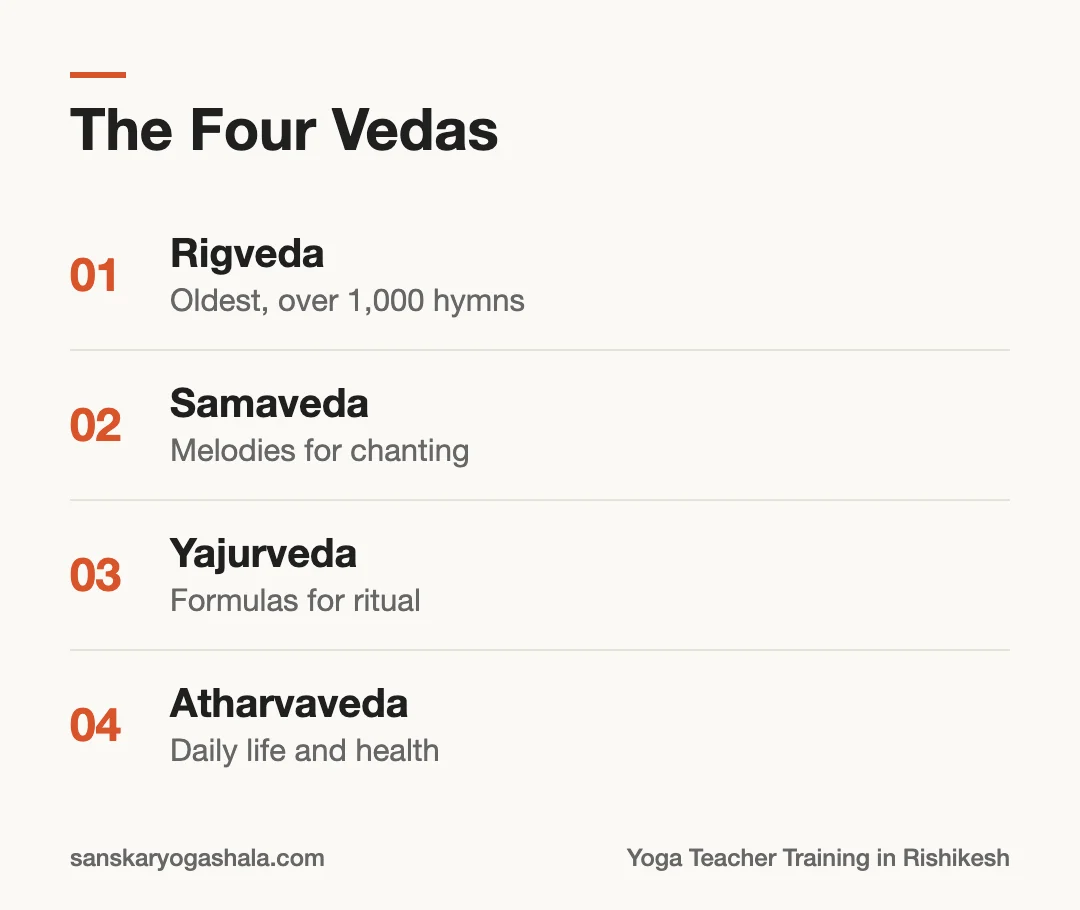
- Rigveda: the oldest Veda, a collection of more than 1,000 hymns praising natural forces and deities.
- Samaveda: the Veda of melodies, with verses set to music for chanting during rituals.
- Yajurveda: the Veda of ritual, with prose formulas and instructions for sacrifices.
- Atharvaveda: hymns and practical knowledge for daily life, health and protection.
The Four Parts of Each Veda
Each Veda has four layers. The Samhitas are the hymns and mantras. The Brahmanas explain rituals. The Aranyakas, or forest texts, move towards meditation. Finally, the Upanishads explore the deepest philosophy of the self and reality.
How the Vedas Connect to Yoga
Many ideas that yoga students learn today have their roots in the Vedas: the sacred sound Om, the power of mantra, the breath as life force, and the search for the true self. Rituals such as the havan, or fire ceremony, also come from the Vedic tradition. Studying the Vedas helps you see yoga as a complete way of life, not only physical exercise.
Why the Vedas Still Matter Today
The Vedas remind us to live in harmony with nature, to act with gratitude and to seek inner knowledge. Their chants are still sung in temples and ashrams across India, including in Rishikesh, where students of yoga often hear Vedic mantras at sunrise and during evening aarti by the Ganga.
Related reading: what the Upanishads are and Yog Darshan, an introduction to yoga philosophy. Yoga philosophy is part of our 200 Hour Yoga Teacher Training in Rishikesh.
Vedas FAQs
What are the Vedas in simple words?
The Vedas are the oldest sacred texts of India. They are collections of hymns, rituals and philosophy that form the foundation of Hindu tradition and yoga.
How many Vedas are there?
There are four Vedas: the Rigveda, Samaveda, Yajurveda and Atharvaveda.
Which is the oldest Veda?
The Rigveda is considered the oldest of the four Vedas.
What is the connection between the Vedas and yoga?
Yoga grew out of Vedic and Upanishadic wisdom. Concepts such as Om, mantra, prana and meditation on the self all have Vedic roots.
What are the Upanishads in relation to the Vedas?
The Upanishads are the final, philosophical part of the Vedas, which is why they are also called Vedanta, the end of the Vedas.