Aum, also written Om, is the most sacred sound in yoga and Indian philosophy. It is described as the sound of the universe and a symbol of the ultimate reality. Chanting Aum calms the mind, slows the breath and creates a feeling of peace, which is why most yoga classes begin and end with it.
This is the primal sound. This is the name of Brahman or god. AUM stands for Brahma the creator, Vishnu the preserver, and Shiva the destroyer. It stands for the whole universe made up of triguna-s or the triple manifestations of nature. They are sattva-guna, inactivity. Esoterically, Aum stands for our physical, astral, and causal bodies, and indicates Atma stands for our physical, astral, and causal bodies.
Aum or Om
And indicates Atma which is beyond the three. A is guttural, U is middle, and M is the labial or end of the vocal cord. In short, Aum stands for all that are manifested and unmanifested. It is the word from everything has come. It is the Nada-Brahma or sound-Brahma. It is the bija or seed Mantra and is usually prefixed to all the other Mantras.Om is the Eternal; Om is this entire universe. Om is the syllable of assent. Saying”Om! Let us hear” they begin the citation. With Om, they sing the hymns of the samba Veda.

With “om shom” they pronounced the sastra-s.Om is Brahman. Om is the sound which projected the universe. During comic dissolution, the universe in Om. Om has no beginning. Om has no end. Om was before time was created. Om is beyond time, space, and causation. Om is beyond past, present, and future. Om is beyond nether, earth, and ethereal regions. Om is beyond sattva (brilliance), rajas (passion), and tames (darkness).Om is the one quest of all the saints. Om is one search of all sages. Om Yoga is the one search of all the science.

Om is the one goal of all the souls. Om is the one truth which is worshipped in diverse ways.Om brings equilibrium Om brings wisdom. Om is the root. Om is the support. Om pervades all. Om brings peace, bliss, and power. Om kills the ego, desires, and doubt. Om is the abode of the soul. Om is the language of god. Om is expressed by god. Om expresses god, Om is god.
The Meaning of Aum
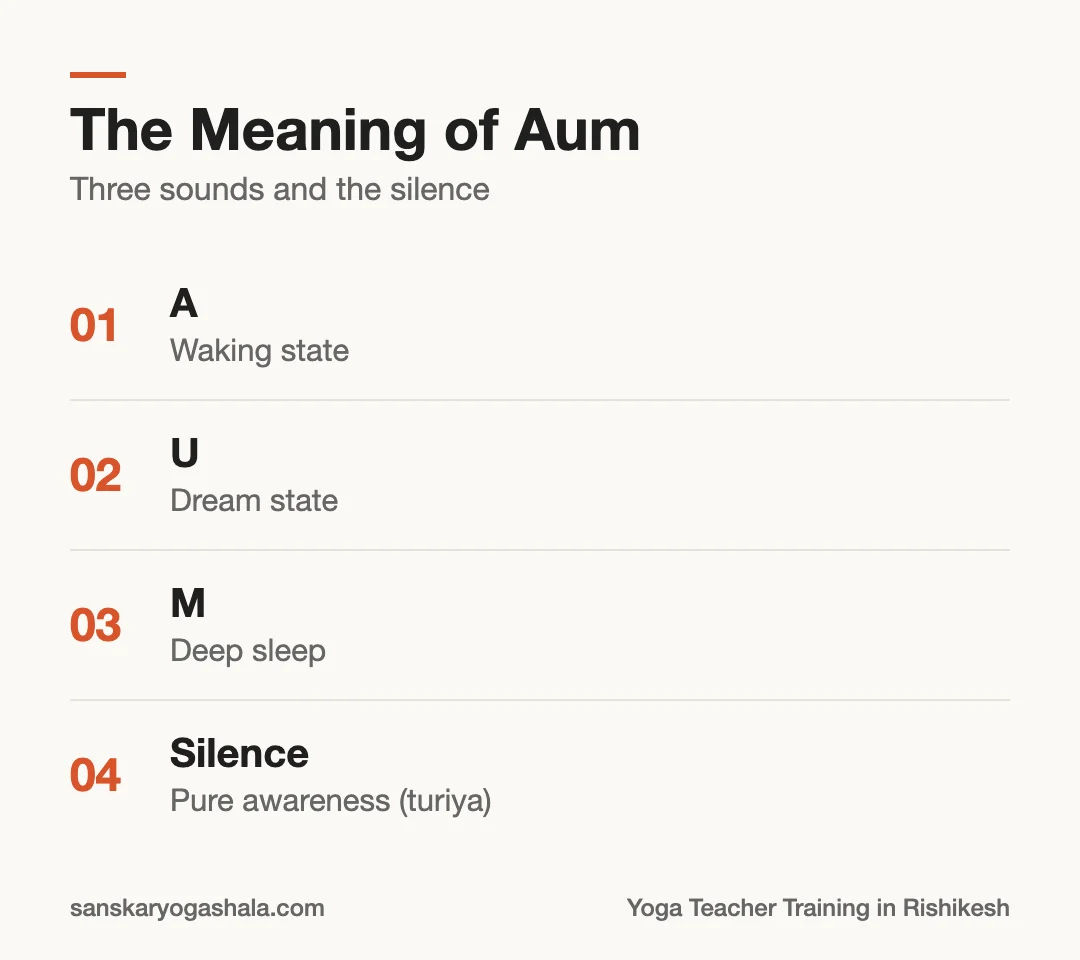
Aum is made of three sounds: A, U and M, followed by silence. The Mandukya Upanishad explains that A stands for the waking state, U for the dream state, M for deep sleep, and the silence after the sound stands for turiya, the pure awareness beyond all three. In this way one short sound holds the whole of human experience.

Aum in Yoga and the Yoga Sutras
Patanjali calls Aum pranava, the sound that expresses Ishvara, the divine. He says that repeating it with feeling for its meaning removes obstacles and turns the mind inward. That is why Aum is used as a mantra for meditation and as an opening to Vedic chants.
How to Chant Aum Correctly
- Sit comfortably with a straight spine and close your eyes.
- Take a slow, deep breath in.
- As you breathe out, open the mouth and say “Aaa”, feeling the sound in the belly.
- Round the lips into “Uuu” and feel it in the chest.
- Close the lips into “Mmm” and feel the vibration in the head.
- Rest in the silence that follows, then repeat 3, 11 or 21 times.
Benefits of Chanting Aum
- Calms the nervous system and reduces stress
- Slows and deepens the breath
- Improves focus before meditation
- Creates a sense of connection in group classes
- Helps quiet racing thoughts before sleep
The Aum Symbol
The written symbol ॐ has three curves, a crescent and a dot. The curves stand for the waking, dream and deep sleep states, the crescent for maya (illusion) and the dot for turiya, the highest consciousness. You will see it on temples, malas and yoga studios across Rishikesh.
Related reading: what a mantra is and what meditation actually means. Chanting and meditation are part of daily practice on our 200 Hour Yoga Teacher Training in Rishikesh.
Aum FAQs
What does Aum mean?
Aum is the sacred sound of the universe in yoga and Hindu philosophy. Its three parts, A, U and M, stand for waking, dreaming and deep sleep, and the silence after it stands for pure awareness.
Is Aum the same as Om?
Yes. Aum and Om are two ways of writing the same sacred sound. Aum shows its three parts more clearly.
Why do we chant Aum at the start of yoga class?
Chanting Aum calms the mind, slows the breath and brings the group together, preparing everyone for practice.
How many times should I chant Aum?
Common counts are 3, 11, 21 or 108. Even three slow chants can calm the mind.
Can anyone chant Aum?
Yes. Aum is a universal sound and anyone can chant it, whatever their religion or background.