In yoga, the mind (manas, part of chitta) is the inner instrument that thinks, feels, remembers and reacts to the world through the senses. Yoga teaches that the mind is not who you truly are. It is a tool that can be trained, and the purpose of yoga is to calm its restless movements so you can see clearly and live with peace.
You may be surprised at this healing. There are few people in the world who don’t know the name of mind. Learned or ignorant, villager or townsman, civilized or uncivilized, most people are familiar with the world “mind”. has special importance in the Vedas also. From time immemorial arguments and differences of opinion exist in relation.

Mind ?
In the time of king janaka, various spiritual conferences were organized, and the main topic of discussion was simply this mind. There has been much anxiety in the human race on this question due to ignorance of its essential nature and its functions. Many functions are even attributed to which don’t belong to it. along is the cause of bondage and liberation of human beings.

Such statements have often been misunderstood. Yoga intellect have been considered one and the same, therefore, there has been confusion regarding their functions. Intermingling of their good and bad functions was all attributed to the mind and human beings had no clear idea what this could.

This is not just the fault of ordinary people. Learned scholars have studied the scriptures and passed on their knowledge to the general public without themselves attaining realization. Nor did they strive to achieve proper research in this matter as is done in most subjects nowadays.
The Mind in Yoga Philosophy
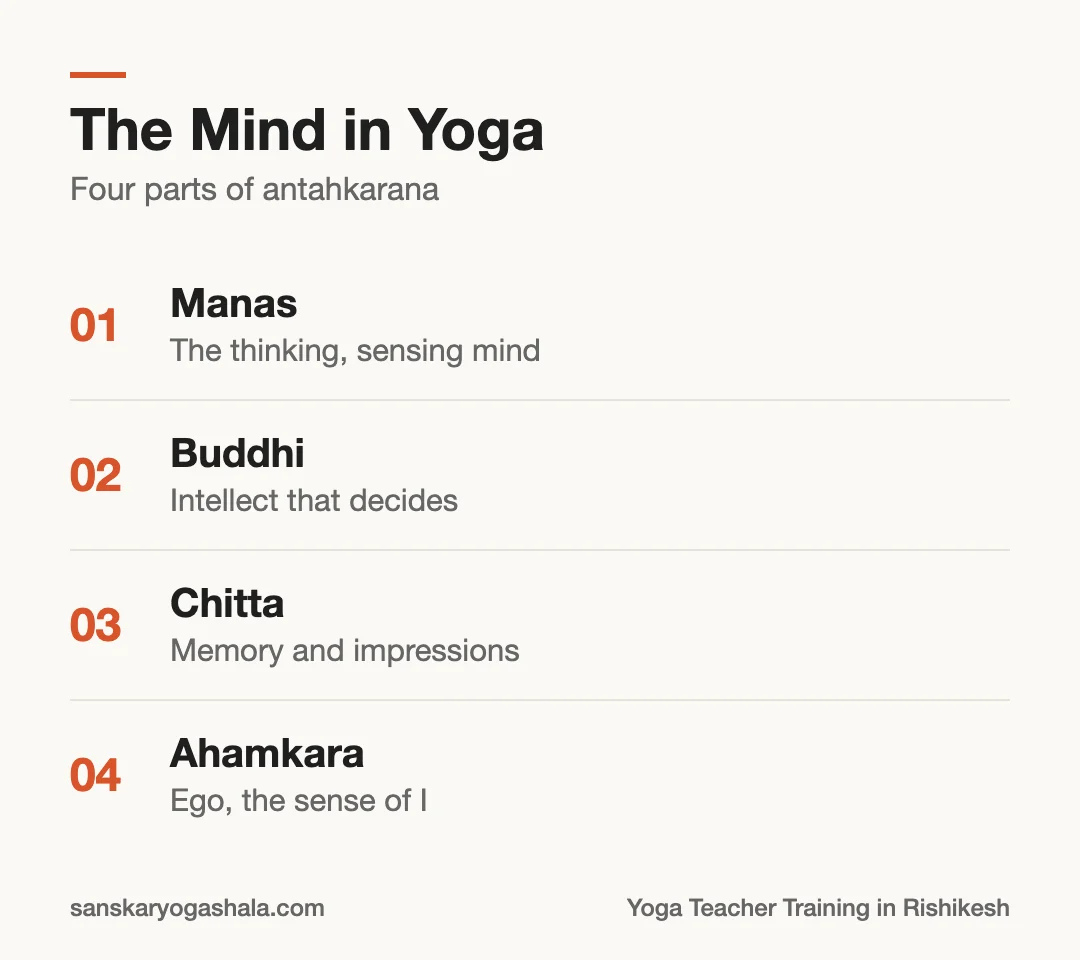
Yoga philosophy describes an inner instrument called antahkarana, which has four parts:
- Manas: the thinking, doubting mind that receives information from the senses.
- Buddhi: the intellect, which decides and discerns right from wrong.
- Ahamkara: the ego, the sense of “I” and “mine”.
- Chitta: the store of memories and deep impressions (samskaras).
When these parts work together in balance, we think clearly and act wisely. When they are disturbed, we feel confused, anxious or stuck in old habits.


What Patanjali Says About the Mind
The second sutra of Patanjali’s Yoga Sutras defines yoga as yogas chitta vritti nirodhah: yoga is the stilling of the movements of the mind. Patanjali names five kinds of mental movement: right knowledge, wrong knowledge, imagination, sleep and memory. Yoga does not try to destroy the mind. It helps the mind become quiet, like a lake without waves, so that our true nature can be seen.
Why the Mind Feels So Restless
Modern life constantly pulls the mind outward through screens, noise and worry. Old habits and unprocessed emotions also keep it busy. Yoga explains that the mind follows wherever our attention and desires go. The more scattered our attention, the more restless the mind becomes.
How Yoga Helps You Train the Mind
- Practice (abhyasa): regular, steady effort, even for a few minutes each day.
- Non-attachment (vairagya): letting go of craving and aversion, so the mind is less pulled around.
- Breathwork: pranayama calms the nervous system, and the mind follows the breath.
- Meditation: focusing on one point slowly reduces mental chatter.
- Mantra: repeating a sacred sound gives the mind a peaceful place to rest.
A Simple Practice to Calm the Mind
Sit comfortably with your spine straight. Close your eyes and take five slow breaths. Then simply watch the breath without changing it. When a thought arises, notice it and gently return to the breath. Start with five minutes a day and slowly increase. Over time you will notice more space between thoughts and more calm in daily life.
Signs Your Mind Is Becoming Calmer
- You react less quickly to small irritations.
- You fall asleep more easily and wake feeling rested.
- You can focus on one task for longer.
- You notice your thoughts instead of being carried away by them.
To learn how yoga works with the mind, read what meditation actually means and what samadhi is. These topics are part of the philosophy classes on our 200 Hour Yoga Teacher Training in Rishikesh.
Mind in Yoga FAQs
What is the mind according to yoga?
Yoga sees the mind as an inner instrument made up of manas (thinking), buddhi (intellect), ahamkara (ego) and chitta (memory). It is a tool we use, not our true self.
What does chitta vritti nirodhah mean?
It is Patanjali’s definition of yoga in Yoga Sutra 1.2. It means yoga is the calming or stilling of the movements of the mind.
How does yoga calm the mind?
Through steady practice and non-attachment, supported by asana, pranayama and meditation, the mind gradually becomes quieter and clearer.
Is the mind the same as consciousness in yoga?
No. Yoga teaches that consciousness (purusha) is the pure witness, while the mind is part of nature (prakriti) that consciousness observes.
How long does it take to calm the mind with yoga?
Many people feel calmer after a few weeks of daily practice. Deep and lasting change comes with patient practice over months and years.